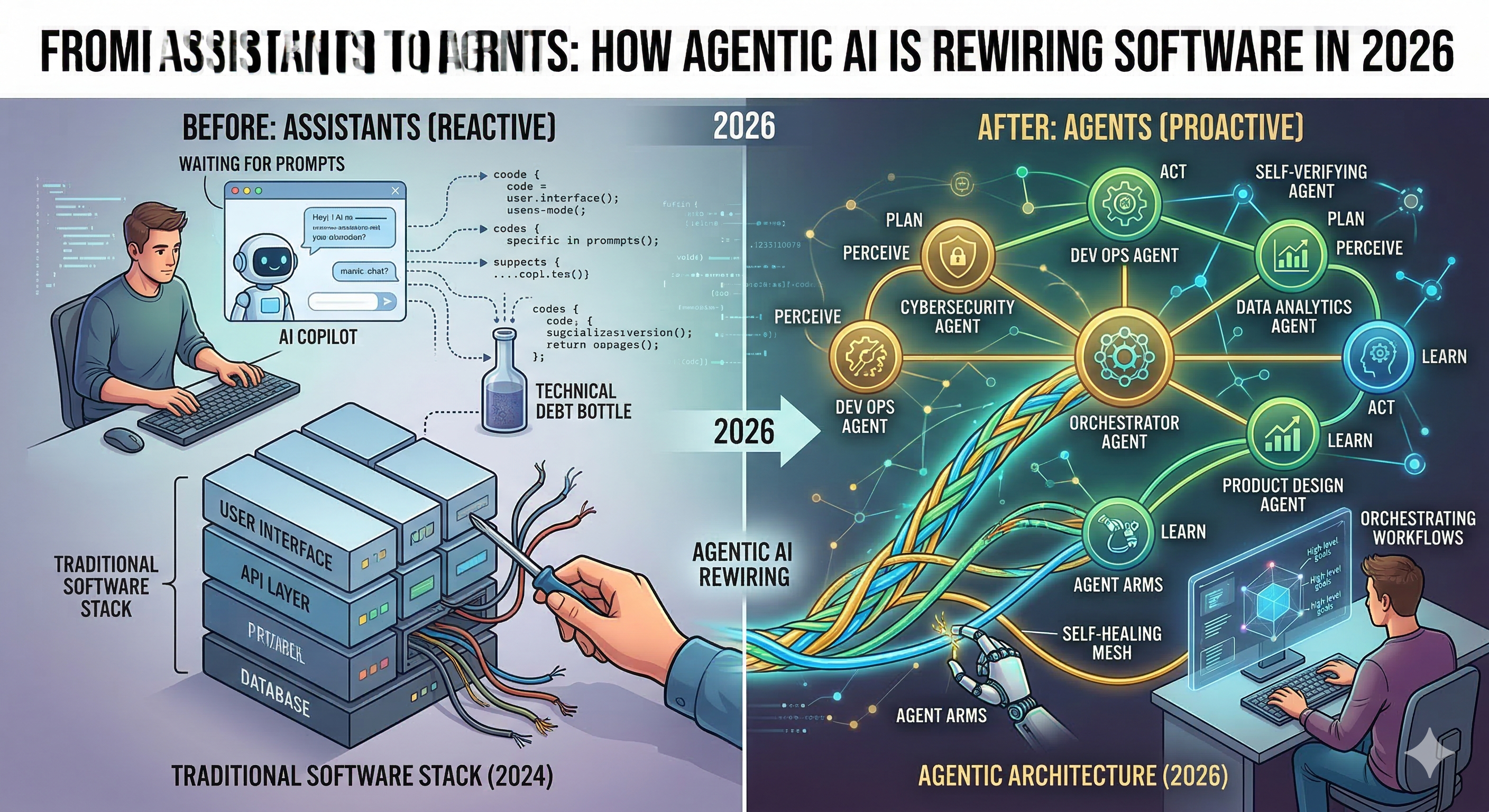
The landscape of artificial intelligence is undergoing a profound transformation, evolving beyond mere task automation and predictive analytics. For years, AI has served as a valuable assistant, augmenting human capabilities and streamlining processes. However, as we approach 2026, a new paradigm is rapidly taking hold: Agentic AI. This isn't just an incremental improvement; it represents a fundamental rewiring of how software is conceived, developed, and interacts with the world. Agentic AI systems are characterized by their ability to autonomously set and pursue goals, plan multi-step actions, learn from experience, and interact dynamically with their environment and other systems. This shift from reactive assistants to proactive, goal-oriented agents promises to redefine efficiency, innovation, and the very architecture of digital solutions across every industry.
Defining the Shift: From Reactive Assistants to Proactive Agents
To truly grasp the impact of agentic AI, it's essential to understand what distinguishes it from its predecessors. The AI systems we've become accustomed to, from chatbots to recommendation engines, largely operate in a reactive mode. They respond to specific prompts, execute predefined functions, and offer insights based on static or semi-static data. Agentic AI, however, introduces a new level of sophistication and independence.
What is Agentic AI?
Agentic AI refers to intelligent systems designed with a degree of autonomy, enabling them to pursue complex objectives without constant human intervention. Key characteristics include:
Goal-Orientation: Agents are given high-level goals and are responsible for breaking them down into actionable steps.
Planning and Reasoning: They can develop and adapt strategies to achieve their goals, anticipating potential obstacles and adjusting their course.
Memory and Context: Agents maintain a persistent memory of past interactions and decisions, allowing them to learn and build context over time. This often involves both short-term working memory for immediate tasks and long-term memory for accumulated knowledge.
Tool Use: They can intelligently select and utilize external tools, APIs, and other software applications to execute tasks, gather information, or interact with the physical world.
Self-Correction and Iteration: Agents can monitor their own performance, identify errors, and refine their strategies through feedback loops, leading to continuous improvement.
This confluence of capabilities allows agentic systems to move beyond simple automation to genuine problem-solving.
The Limitations of Traditional AI Assistants
While invaluable, traditional AI assistants often operate within constrained frameworks. A typical AI assistant might:
Respond to a specific query (e.g., "What's the weather?").
Execute a predefined workflow (e.g., "Book me a meeting with John").
Analyze data based on explicit instructions (e.g., "Summarize Q3 sales data").
Their limitations stem from their reliance on explicit programming or highly structured prompts. They lack the intrinsic drive to explore, infer, or independently strategize beyond their immediate instructions. If a task requires an unexpected deviation or an unforeseen step, a traditional assistant will typically halt or require further human input.
The Paradigm Shift: Dynamic, Self-Improving, Complex Problem-Solving
The transition to agentic AI represents a fundamental paradigm shift. Instead of receiving explicit instructions for every step, agents are given a mission. For instance, instead of "write code for feature X," an agent might be tasked with "improve user engagement by 15% on product Y." The agent would then autonomously investigate, plan, design, code, test, and deploy solutions, learning and iterating along the way. This shift empowers software to become not just a tool, but a collaborative partner capable of tackling complex, open-ended problems with a high degree of autonomy. By 2026, this capability is expected to be integrated into the core fabric of enterprise software, transforming everything from supply chain management to customer relationship management.
"The future of software isn't about telling AI what to do, but defining what we want to achieve and letting agents figure out the how. It's a move from instruction-based interaction to intent-driven collaboration."
The Core Mechanics of Agentic Systems in 2026
Underpinning the capabilities of agentic AI are sophisticated architectural components that allow them to mimic human-like cognition in task execution. These mechanics are rapidly maturing, forming the bedrock of the agentic software landscape by 2026.
Enhanced Reasoning and Planning Capabilities
At the heart of agentic AI is an advanced reasoning engine that enables multi-step planning. Unlike simple conditional logic, these agents can:
Deconstruct Complex Goals: Break down a high-level objective into a series of smaller, manageable sub-goals.
Generate Action Sequences: Formulate a logical sequence of actions required to achieve each sub-goal.
Anticipate and Adapt: Foresee potential roadblocks or dependencies and dynamically adjust their plan in real-time based on new information or unforeseen outcomes.
Strategic Thinking: Evaluate different approaches and select the most optimal path, considering factors like efficiency, resource allocation, and risk.
For example, an agent tasked with "optimizing cloud infrastructure costs" wouldn't just suggest a single action; it would analyze usage patterns, identify underutilized resources, propose migration strategies, simulate cost savings, and then orchestrate the necessary configuration changes across multiple cloud services.
Memory and Contextual Awareness
Effective autonomy requires more than just real-time processing; it demands a robust memory system. Agentic AI in 2026 leverages sophisticated memory architectures:
Short-Term Working Memory: Keeps track of the current task, recent interactions, and immediate context, much like human working memory. This allows for coherent, multi-turn conversations and task execution.
Long-Term Knowledge Base: Stores accumulated information, learned experiences, and domain-specific knowledge. This often involves advanced techniques like Retrieval Augmented Generation (RAG) to pull relevant information from vast, unstructured datasets, ensuring decisions are informed by a comprehensive understanding of past events and established facts.
Episodic Memory: Records specific experiences and their outcomes, allowing agents to learn from both successes and failures, preventing repetition of past mistakes and reinforcing successful strategies.
This persistent memory allows agents to build a rich understanding of their operating environment and the specific demands of their ongoing tasks.
Tool Use and API Integration
A critical enabler for agentic AI is its ability to interact with the digital world as fluently as a human. This involves:
Intelligent Tool Selection: Agents can identify which external tools (e.g., databases, CRM systems, code repositories, web search engines, communication platforms) are most appropriate for a given task.
Dynamic API Interaction: They can construct and execute complex API calls, parse responses, and integrate data from disparate systems. This transforms the internet and enterprise software ecosystem into a vast toolkit for the agent.
"Browser" Capabilities: Some advanced agents can navigate web browsers autonomously, visiting websites, extracting data, filling forms, and even completing multi-step tasks that typically require human interaction with web interfaces. This transforms the agent into a virtual employee capable of handling complex online workflows. This ability to autonomously operate across multiple tools and platforms is what makes agentic AI so powerful. Rather than being confined to a single application or database, agents become orchestrators that weave together disparate systems to accomplish complex objectives.
Real-World Applications of Agentic AI in 2026
The theoretical capabilities of agentic AI translate into tangible, transformative applications across virtually every industry. By 2026, these applications are no longer experimental; they are reshaping business operations at scale.
Software Development and DevOps
Agentic AI is revolutionizing the software development lifecycle. Development agents can now:
Autonomous code generation and refactoring: Agents analyze existing codebases, identify technical debt, propose architectural improvements, and implement changes while maintaining backward compatibility.
Intelligent debugging: Rather than just flagging errors, agents investigate root causes, trace through execution paths, and suggest precise fixes with confidence scores.
Continuous deployment orchestration: Agents monitor CI/CD pipelines, automatically roll back failed deployments, run post-deployment validation tests, and optimize infrastructure configurations in real-time.
Security patching: Agents continuously scan for vulnerabilities, prioritize them based on exploitability and impact, and deploy patches with minimal human intervention.
For a Laravel developer managing multiple servers, an agentic AI assistant could autonomously monitor server health, analyze log files for anomalies, scale resources during traffic spikes, and even deploy updates across multiple environments with proper rollback procedures.
Enterprise Operations
In enterprise settings, agentic AI systems act as virtual departments:
Supply chain management: Agents predict demand fluctuations, negotiate with suppliers, optimize inventory levels, and reroute shipments in response to disruptions.
Customer relationship management: Agents personalize customer interactions at scale, anticipate needs before they're expressed, and coordinate across marketing, sales, and support teams.
Financial analysis and compliance: Agents process vast financial datasets, detect anomalies indicative of fraud, ensure regulatory compliance, and generate audit-ready reports.
Healthcare and Research
Agentic AI is accelerating medical research and improving patient care:
Drug discovery: Agents screen millions of molecular compounds, simulate biological interactions, and identify promising candidates for clinical trials in a fraction of traditional timelines.
Personalized treatment plans: Agents analyze patient histories, genetic profiles, and the latest research to recommend tailored treatment strategies.
Medical literature synthesis: Agents continuously scan thousands of medical journals, extract relevant findings, and update clinical guidelines in real-time.
Content Creation and Digital Marketing
The content landscape is being transformed by agentic systems:
End-to-end content production: Agents research topics, outline articles, write drafts, optimize for SEO, schedule publication, and analyze performance metrics to refine future content.
Multi-channel campaign management: Agents orchestrate marketing campaigns across email, social media, search ads, and content platforms, adjusting strategies based on real-time performance data.
Dynamic content personalization: Agents tailor website content, product recommendations, and messaging to individual users based on their behavior, preferences, and purchase history.
Challenges and Ethical Considerations
Despite their transformative potential, agentic AI systems introduce significant challenges that must be addressed as adoption accelerates in 2026.
Alignment and Control
One of the foremost concerns is ensuring that autonomous agents remain aligned with human values and intentions. An agent pursuing a goal with excessive zeal might take unintended or harmful actions in its quest for optimization. Robust oversight mechanisms, clear constraint boundaries, and the ability to intervene and override agent decisions are essential safeguards.
Transparency and Explainability
As agents make increasingly complex decisions autonomously, understanding the rationale behind those decisions becomes critical. Stakeholders need to be able to audit agent actions, trace decision-making paths, and ensure accountability. The development of explainable AI (XAI) techniques tailored to agentic systems is a key area of research and implementation.
Security and Adversarial Exploitation
Agentic AI's access to tools and APIs creates new attack surfaces. Adversaries could attempt to manipulate agent behavior through crafted inputs, hijack agent actions for malicious purposes, or exploit vulnerabilities in the tools agents interact with. Comprehensive security frameworks specifically designed for autonomous systems are a top priority.
Impact on Employment
The ability of agentic AI to perform complex tasks traditionally requiring human expertise raises significant questions about workforce displacement. While these systems can augment human capabilities and create new job categories, proactive policies for reskilling, education reform, and social adaptation are necessary to ensure equitable benefits from this technological shift.
Legal and Regulatory Frameworks
As agents take autonomous actions with real-world consequences, existing legal frameworks struggle to keep pace. Questions around liability when an agent's decision causes harm, intellectual property rights for agent-generated outputs, and regulatory compliance for autonomous systems require thoughtful, forward-looking policy development.
The Future Outlook: Agentic AI as the New Operating System
By 2026, we are witnessing the emergence of agentic AI as the new operating system for software. Just as traditional operating systems abstract hardware complexity and provide standardized interfaces for applications, agentic AI abstracts the complexity of goal-oriented task execution and provides a framework for autonomous problem-solving.
The convergence of advanced language models, retrieval systems, tool integration frameworks, and long-term memory architectures has created a perfect storm for this paradigm shift. Leading tech companies are already embedding agentic capabilities into their core products, and the next wave of startups will be built entirely around agentic AI architectures.
For developers, the implications are profound. The skillset of the future developer will increasingly involve designing agent objectives, curating tool libraries, establishing safety guardrails, and orchestrating multi-agent collaborations. Traditional coding remains important, but it becomes part of a broader discipline of agent engineering.
For businesses, agentic AI represents an unprecedented opportunity to scale expertise, reduce operational costs, and innovate at a pace previously unimaginable. Organizations that successfully integrate agentic AI into their operations will gain significant competitive advantages in efficiency, customer satisfaction, and strategic agility.
Conclusion
The transition from AI assistants to agentic AI systems marks a watershed moment in the evolution of artificial intelligence and software. No longer confined to responding to prompts or executing predefined workflows, AI agents now possess the capability to understand goals, plan actions, interact with complex environments, and learn from experience.
This shift from reactive tools to proactive partners is rewriting the software landscape across every industry. From autonomous code generation and intelligent DevOps to supply chain optimization, medical research acceleration, and personalized marketing, agentic AI is already delivering tangible value at scale.
Yet this power comes with responsibility. Ensuring alignment, transparency, security, and equitable access to the benefits of agentic AI will require sustained effort from researchers, developers, policymakers, and business leaders alike.
As we navigate through 2026, one thing is clear: the era of agentic AI has arrived. The question is no longer whether organizations will adopt these technologies, but how quickly and how wisely they can harness their potential to create meaningful value for humanity.
For developers building the next generation of applications, the message is clear: the future belongs to those who can design, deploy, and govern intelligent agents that augment human capability rather than replace it. The rewiring of software has begun, and the possibilities are limitless.