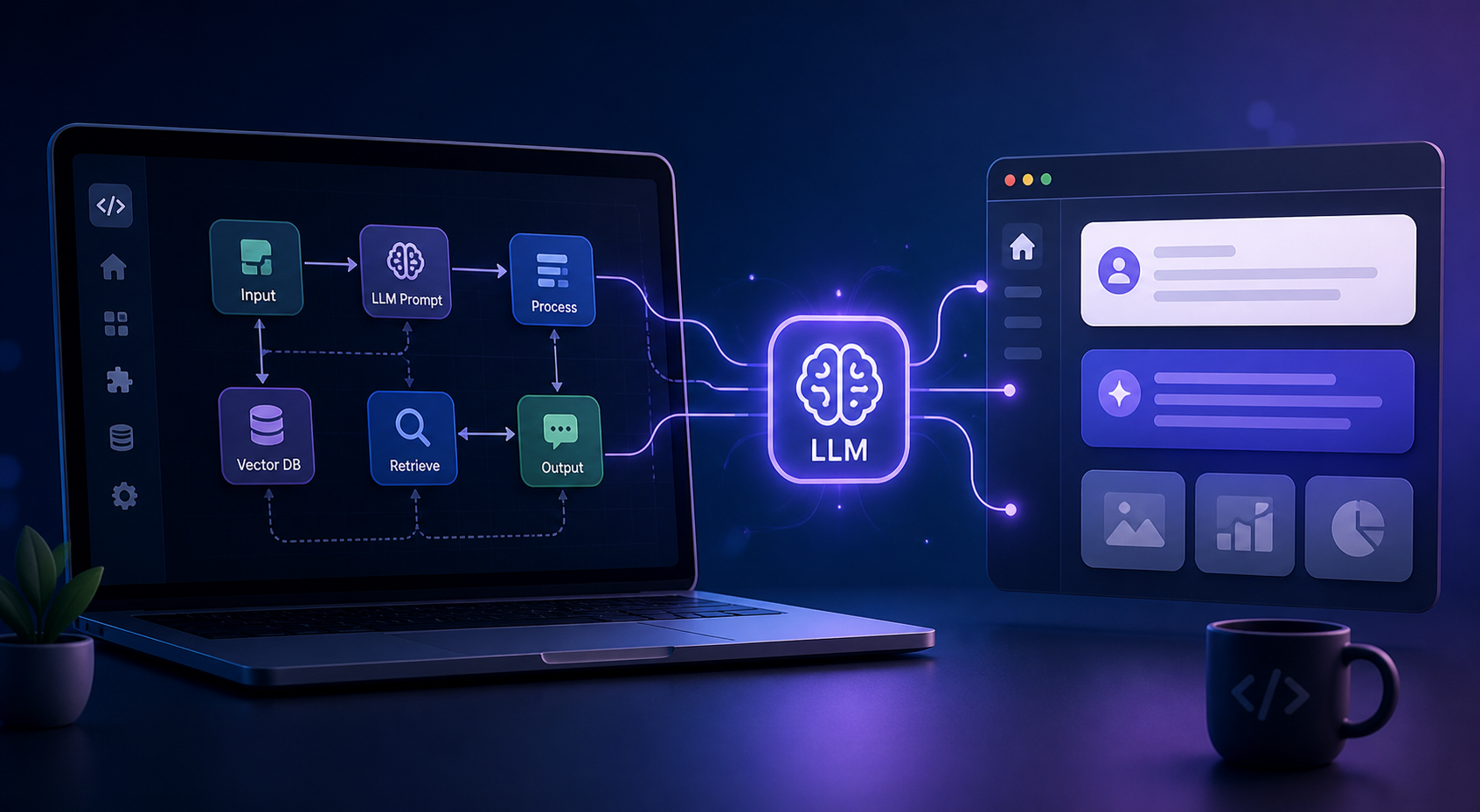
The landscape of web development is undergoing a profound transformation, driven by the burgeoning capabilities of Large Language Models (LLMs). What began as an exploration of third-party API integrations for basic text generation or summarization has rapidly evolved into a sophisticated demand for custom, deeply integrated LLM workflows. Modern web applications are no longer content with generic AI responses; they seek intelligent systems that understand context, leverage proprietary data, and execute complex, multi-step tasks tailored to specific user needs and business objectives. This shift signifies a new frontier for developers, presenting both unprecedented opportunities and intricate challenges in crafting truly intelligent and dynamic user experiences. The journey from simply calling an API to architecting a bespoke LLM ecosystem within a web application requires a comprehensive blueprint, covering everything from architectural design to ethical considerations and continuous iteration.
Understanding the Paradigm Shift: Beyond Generic LLM APIs
For many developers, the initial foray into LLMs involved leveraging readily available APIs from providers like OpenAI, Google, or Anthropic. These services offered a convenient entry point, enabling rapid prototyping of features such as content generation, basic chatbots, or text summarization. While incredibly powerful for broad applications, their inherent generality often meant compromises in precision, domain specificity, and the ability to integrate deeply with application logic or proprietary data sources. Developers quickly realized that to unlock the true potential of LLMs, a more tailored approach was necessary, moving beyond a one-size-fits-all model to create highly specialized, context-aware AI functionalities that resonate with a particular application's unique ecosystem and user base. This evolution highlights a crucial pivot in how we perceive and implement AI.
The Limitations of Off-the-Shelf Solutions
Generic LLM APIs, while accessible and robust, come with inherent limitations when applied to specialized domains or complex business processes. Their training data is vast but often lacks the specific nuances, terminology, or contextual understanding required for niche applications. This can lead to outputs that are factually incorrect within a specific domain, lack the desired tone or style, or fail to adhere to brand guidelines. Furthermore, reliance on external APIs means that proprietary data often needs to be sent to third-party servers, raising significant data privacy and security concerns for many enterprises. The inability to finely control the model's behavior, its internal knowledge base, or its interaction with other application components often restricts innovation and limits the depth of intelligence that can be embedded into a web app. The pursuit of truly intelligent and context-aware systems necessitates a move beyond these inherent constraints.
Another significant drawback is the lack of direct control over the model's architecture and parameters. Developers are typically limited to the exposed API endpoints and configuration options, which might not be sufficient for optimizing performance, cost, or specific behavioral traits. For instance, fine-grained control over sampling temperature, top-p, or penalty scores might be available, but modifying the underlying model architecture or incorporating custom layers is generally out of reach. This lack of extensibility can hinder the development of highly differentiated features or the optimization of resource utilization for specific workloads. Consequently, organizations looking to build truly cutting-edge, proprietary AI features often find off-the-shelf solutions to be more of a starting point rather than a final destination, pushing them towards more customized integration strategies.
The Power of Customization
Customization transforms LLMs from general-purpose tools into specialized powerhouses. By fine-tuning models on proprietary datasets, developers can imbue them with an understanding of specific industry jargon, company policies, customer interaction histories, or product specifications. This leads to outputs that are not only accurate but also highly relevant and contextually appropriate, significantly enhancing user satisfaction and operational efficiency. Moreover, custom workflows allow for the seamless integration of LLMs with existing databases, APIs, and business logic, enabling the creation of complex agentic systems that can perform multi-step reasoning, retrieve dynamic information, and interact with external tools. This level of integration ensures that the LLM acts as an intelligent extension of the application, rather than a disconnected service, unlocking unprecedented levels of automation and personalized user experiences.
The ability to tailor an LLM's behavior extends beyond data ingestion. It encompasses designing specific prompt chains, implementing retrieval-augmented generation (RAG) patterns, and orchestrating complex decision trees. This allows developers to build sophisticated agents that can, for example, answer customer support queries by looking up CRM data, generate personalized marketing copy based on user segments, or even assist in code development by understanding project context and existing codebase patterns. Such bespoke solutions offer a significant competitive advantage, differentiating applications in crowded markets by providing uniquely intelligent and responsive features. This strategic approach to LLM integration ensures that the AI serves the specific needs of the application and its users, driving innovation and delivering tangible business value.
Architectural Considerations for LLM Integration
Integrating custom LLM workflows into modern web applications demands careful architectural planning. Decisions made at this stage will profoundly impact performance, scalability, security, and maintainability. A holistic view is essential, encompassing where the processing occurs, how data flows, and what mechanisms are in place to ensure robust operation under varying loads. Developers must weigh the trade-offs between client-side efficiency and server-side control, consider the implications of data residency and compliance, and design for future growth. The goal is to create an infrastructure that not only supports current LLM capabilities but is also flexible enough to adapt to rapidly evolving AI technologies and increasing user demands. This foundational planning is crucial for long-term success and avoiding costly refactoring down the line.
Client-Side vs. Server-Side Processing
The choice between client-side and server-side LLM processing is a fundamental architectural decision. Client-side processing, often leveraging smaller, optimized models or on-device inference engines, offers advantages in terms of reduced server load, lower latency, and enhanced data privacy, as sensitive information may not need to leave the user's device. This approach is suitable for tasks like local text generation, input validation, or basic summarization where model size and computational demands are manageable. However, it is constrained by device capabilities, limits access to large, powerful models, and complicates model updates. Server-side processing, conversely, provides access to the most advanced and resource-intensive LLMs, enables centralized data management, and simplifies model deployment and updates. It is ideal for complex tasks requiring significant computational power, extensive knowledge bases, or real-time integration with backend systems, though it introduces concerns regarding latency, server costs, and data transmission security. A hybrid approach, where lightweight tasks are handled client-side and complex ones are offloaded to the server, often strikes the optimal balance.
When considering client-side LLM implementations, frameworks like ONNX Runtime or WebAssembly can facilitate running optimized models directly in the browser or on mobile devices. This can be particularly effective for applications that prioritize immediate feedback or operate in offline environments. For example, a note-taking app might use a small client-side LLM for real-time grammar correction or semantic tagging. However, the overhead of downloading model weights and the limitations of JavaScript execution environments can impact initial load times and overall performance for larger models. Server-side integration, typically via REST APIs or gRPC, allows for leveraging GPU-accelerated inference farms and integrating with existing microservices architectures. This offers greater flexibility in model choice and scaling, but requires robust API management, load balancing, and careful consideration of network latency, especially for interactive applications. The decision hinges on specific use cases, performance requirements, and data sensitivity.
Data Flow and Security Implications
Managing the flow of data is paramount when integrating LLMs. This includes not only the input prompts and generated outputs but also any proprietary or sensitive information used for fine-tuning, retrieval-augmented generation (RAG), or contextual understanding. Secure data pipelines must be established, employing encryption both in transit (TLS/SSL) and at rest (disk encryption). Access controls must be rigorously implemented, ensuring that only authorized services and personnel can interact with LLM endpoints and associated data stores. For applications handling personal identifiable information (PII) or protected health information (PHI), anonymization or pseudonymization techniques should be applied before data is processed by the LLM, especially if using third-party services. Furthermore, robust logging and auditing mechanisms are essential to monitor data access and model interactions, providing a clear trail for compliance and incident response. Developers must consider data residency requirements, ensuring that data processing adheres to regional regulations like GDPR or CCPA, which often dictates where data can be stored and processed, impacting the choice of LLM provider or deployment strategy.
"In the age of AI, data is not just fuel; it's a liability if not handled with the utmost care. Secure data flow and robust privacy protocols are non-negotiable for building trust and ensuring compliance in LLM-powered applications." - AI Security Expert
Establishing a secure data flow involves more than just encryption. It requires a comprehensive threat model that identifies potential vulnerabilities at every stage of the LLM workflow. This includes securing API keys, preventing prompt injection attacks, and safeguarding against data leakage through model outputs. Implementing a robust authorization layer ensures that requests to the LLM are legitimate and originate from authenticated sources. For RAG systems, the vector database holding sensitive embeddings must be equally protected, potentially residing within a private network or employing database-level encryption and access controls. Furthermore, the practice of red-teaming LLM applications to proactively identify and mitigate security weaknesses is becoming increasingly important. Developers need to think about data minimization principles, only sending the necessary information to the LLM, and implementing strict data retention policies to reduce the attack surface. This multi-layered approach to security is indispensable for fostering user trust and maintaining regulatory compliance.
Scalability and Performance Planning
LLM integrations introduce significant computational demands, making scalability and performance critical considerations. The architecture must be designed to handle varying loads, from a handful of concurrent users to thousands, without compromising response times. This typically involves leveraging cloud-native solutions, such as serverless functions for API endpoints, managed Kubernetes clusters for containerized LLM services, and auto-scaling groups for compute instances. Implementing caching strategies for frequently requested LLM outputs or intermediate results can significantly reduce latency and operational costs. Load balancing is essential to distribute inference requests across multiple model instances, ensuring high availability and efficient resource utilization. Performance monitoring tools must be integrated from the outset to track key metrics like latency, throughput, and error rates, enabling proactive identification and resolution of bottlenecks. Planning for scalability also involves anticipating future growth in model complexity and user volume, ensuring that the underlying infrastructure can be easily upgraded or expanded without major architectural overhauls.
Optimizing for performance extends to the choice of LLM inference runtime and hardware. Utilizing specialized hardware accelerators like GPUs or TPUs is often necessary for high-throughput, low-latency inference, especially with larger models. Frameworks such as NVIDIA Triton Inference Server or Hugging Face's Inference Endpoints offer optimized solutions for deploying and scaling LLM models. Techniques like batching multiple requests, model quantization (reducing precision of model weights), and model pruning (removing less important connections) can further improve inference speed and reduce memory footprint. For real-time interactive applications, minimizing network round trips and optimizing prompt structure to reduce token count are crucial. A well-designed performance strategy also includes setting realistic service level objectives (SLOs) and service level indicators (SLIs) for LLM responses, ensuring that the application delivers a consistent and responsive user experience under various operational conditions. This proactive approach to performance tuning is vital for the success of any LLM-powered web application.
Choosing the Right LLM Model and Frameworks
The rapidly expanding ecosystem of Large Language Models and their supporting frameworks presents both opportunities and challenges for developers. Selecting the appropriate LLM and orchestration tools is a critical decision that impacts everything from development velocity and cost to the ultimate capabilities and performance of the integrated workflow. This choice is not merely about picking the "best" model, but rather identifying the one that aligns most closely with the application's specific requirements, data availability, computational resources, and long-term strategic goals. A careful evaluation of open-source versus proprietary options, along with an understanding of how to leverage fine-tuning and pre-training, is essential for building a robust and effective LLM-powered web application. The decision matrix is complex, requiring a deep understanding of the trade-offs involved in each option.
Open-Source vs. Proprietary Models
The debate between open-source and proprietary LLMs is central to architectural planning. Proprietary models, offered by leading AI companies, typically provide cutting-edge performance, extensive support, and often simpler API integrations. They benefit from continuous research and development by large teams, frequently leading to superior benchmarks in general tasks. However, they come with vendor lock-in, potentially higher costs, and limitations on customization or access to the model's internal workings. Data privacy can also be a concern, as inputs are processed on the vendor's infrastructure. Open-source models, such as those from Hugging Face, Meta, or various community projects, offer unparalleled flexibility. Developers can host them on their own infrastructure, fine-tune them extensively with proprietary data without data egress, and even modify their architectures. This provides greater control, potentially lower long-term costs (by avoiding per-token fees), and enhanced data security. The trade-off often lies in the need for significant internal expertise to deploy, manage, and optimize these models, as well as the computational resources required for self-hosting. The choice depends heavily on the specific use case, budget, and internal capabilities. For applications requiring maximum control, data privacy, and deep customization, open-source models present a compelling option, despite the increased operational complexity.
Furthermore, the rapid pace of innovation in the open-source LLM community means that new, highly capable models are regularly released, often rivaling or even surpassing the performance of proprietary alternatives for specific tasks. This dynamic environment allows developers to experiment with different model sizes and architectures to find the optimal balance between performance and resource consumption. For instance, smaller open-source models can be highly effective for edge deployments or scenarios where computational resources are constrained, offering a cost-efficient alternative to larger, proprietary models. The ability to audit the model's weights and architecture also contributes to greater transparency and interpretability, which is crucial for applications in regulated industries or those requiring robust ethical considerations. However, the responsibility for security patches, updates, and performance optimizations falls squarely on the development team when adopting open-source solutions. This necessitates a strong internal MLOps capability to manage the lifecycle of these models effectively. Ultimately, the decision should be a strategic one, balancing immediate needs with long-term vision and resource allocation.
Leveraging Fine-Tuning and Pre-training
To move beyond generic responses, developers must consider leveraging fine-tuning and pre-training techniques. Pre-training involves training an LLM from scratch on a massive, diverse dataset, a resource-intensive task typically undertaken by large research institutions or companies. For most developers, the focus will be on fine-tuning an existing pre-trained model. Fine-tuning adapts a base model to a specific task or domain by training it further on a smaller, highly relevant dataset. This process adjusts the model's weights to better understand domain-specific language, generate particular styles of text, or perform specialized functions. For example, an LLM could be fine-tuned on a company's customer support transcripts to better handle specific product queries or on legal documents to understand complex jargon. This dramatically improves relevance, reduces hallucination, and enhances overall performance for the target application, making the LLM a true expert in its niche rather than a generalist. The quality and size of the fine-tuning dataset are critical determinants of success.
Beyond traditional fine-tuning, techniques like LoRA (Low-Rank Adaptation) allow for efficient adaptation of large models with significantly fewer computational resources and data. This makes fine-tuning more accessible for developers with limited budgets or smaller datasets. Another powerful approach is Retrieval-Augmented Generation (RAG), which dynamically injects relevant context from an external knowledge base into the LLM's prompt at inference time. This bypasses the need for extensive fine-tuning on proprietary data for factual retrieval, instead relying on vector databases to store and retrieve pertinent information. RAG combines the generative power of LLMs with the accuracy of external data sources, mitigating issues like hallucination and ensuring responses are grounded in up-to-date, authoritative information. A common workflow involves embedding a company's documents into a vector database, then using a user's query to retrieve the most relevant document chunks, which are then fed to the LLM along with the original query to generate a informed response. This hybrid approach often provides the best of both worlds: domain specificity without the immense cost of full fine-tuning.
Frameworks for Orchestration (LangChain, LlamaIndex, etc.)
Integrating LLMs into complex workflows goes beyond simple API calls; it requires orchestration frameworks that manage the entire lifecycle of an LLM application. Frameworks like LangChain and LlamaIndex have emerged as indispensable tools for developers. They provide abstractions for common LLM patterns, such as chaining multiple LLM calls, integrating with external data sources (vector databases, APIs), creating agents that can use tools, and managing conversational memory. LangChain, for instance, offers a modular architecture that allows developers to combine "chains" for specific tasks, "agents" for decision-making, and "tools" for interacting with the outside world. LlamaIndex, on the other hand, specializes in connecting LLMs with custom data sources, making it easier to build RAG applications by providing robust indexing and retrieval capabilities. These frameworks significantly accelerate development, simplify complex interactions, and provide a structured approach to building sophisticated LLM-powered applications. Choosing the right framework depends on the primary use case: LangChain for agentic behavior and complex multi-step processes, and LlamaIndex for data augmentation and retrieval-focused applications. Many developers find value in combining elements from both to create comprehensive solutions.
These orchestration frameworks are not just libraries; they are ecosystems that provide a rich set of components and integrations. They abstract away much of the boilerplate code involved in managing prompts, parsing outputs, handling errors, and interacting with various LLM providers. For example, they offer standardized interfaces for different LLM APIs, enabling developers to switch between models with minimal code changes. They also provide mechanisms for caching, rate limiting, and cost tracking, which are essential for production deployments. The community support around these frameworks is vibrant, offering numerous examples, plugins, and best practices. As LLM applications become more complex, requiring multiple interactions with different models, external tools, and dynamic data, these orchestration layers become critical for maintaining code readability, scalability, and debugging efficiency. They empower developers to focus on the business logic and user experience rather than getting bogged down in the intricacies of LLM API management and data retrieval. Mastery of these tools is quickly becoming a core skill for any developer building advanced AI-powered web applications.
Designing Custom LLM Workflows: Core Principles
The true power of integrating LLMs lies in designing custom workflows that go beyond simple question-answering. This involves a thoughtful approach to defining user journeys, meticulous prompt engineering, and the strategic chaining of LLM calls with external tools. A well-designed workflow transforms a generic LLM into an intelligent assistant capable of executing multi-step tasks, understanding complex instructions, and adapting to dynamic contexts. It's about orchestrating a symphony of AI capabilities and traditional software logic to deliver highly specific and valuable outcomes. This design phase requires a deep understanding of both the LLM's capabilities and the nuances of the target application's domain, ensuring that the AI seamlessly augments the user experience rather than merely providing isolated responses. The iterative nature of this process is also key, as fine-tuning and refinement are continuous.
Defining User Journeys and Use Cases
Before writing a single line of code, developers must meticulously define the user journeys and specific use cases that the LLM workflow aims to address. This involves mapping out how users will interact with the AI, what problems the LLM will solve, and what value it will provide at each stage. For example, in an e-commerce application, a user journey might involve asking for product recommendations, comparing features, drafting a review, or troubleshooting an order. Each of these scenarios represents a distinct use case that requires a tailored LLM workflow. Clearly articulating these journeys helps in identifying the necessary data inputs, the desired outputs, the external tools the LLM might need to interact with (e.g., product database, order management system), and the decision points within the workflow. This user-centric approach ensures that the LLM integration is purposeful and directly addresses genuine user needs, avoiding the pitfall of integrating AI for the sake of it. Persona development and scenario planning are invaluable exercises at this stage.
Consider a customer support application where an LLM is integrated. A user journey might start with a customer asking "How do I reset my password?". The LLM workflow would need to identify this as a password reset request, potentially prompt the user for verification details, interact with an authentication API to initiate the reset process, and then confirm the action to the user. Another journey might involve a customer asking about a specific product feature. Here, the LLM would need to query a product knowledge base, summarize the relevant information, and present it clearly. Each step in these journeys requires careful consideration of the LLM's role, the information it needs, and the actions it can take. By breaking down complex interactions into discrete, manageable steps, developers can design robust and predictable LLM workflows. This foundational understanding ensures that the AI's capabilities are leveraged effectively to create intuitive and highly functional user experiences.
Prompt Engineering Best Practices
Prompt engineering is the art and science of crafting effective inputs to guide LLMs towards desired outputs. It's arguably the most crucial skill in custom LLM workflow design. Best practices include providing clear, concise, and unambiguous instructions, using delimiters to separate different parts of a prompt (e.g., user query, context, examples), and specifying the desired output format (e.g., JSON, markdown). Incorporating relevant context,