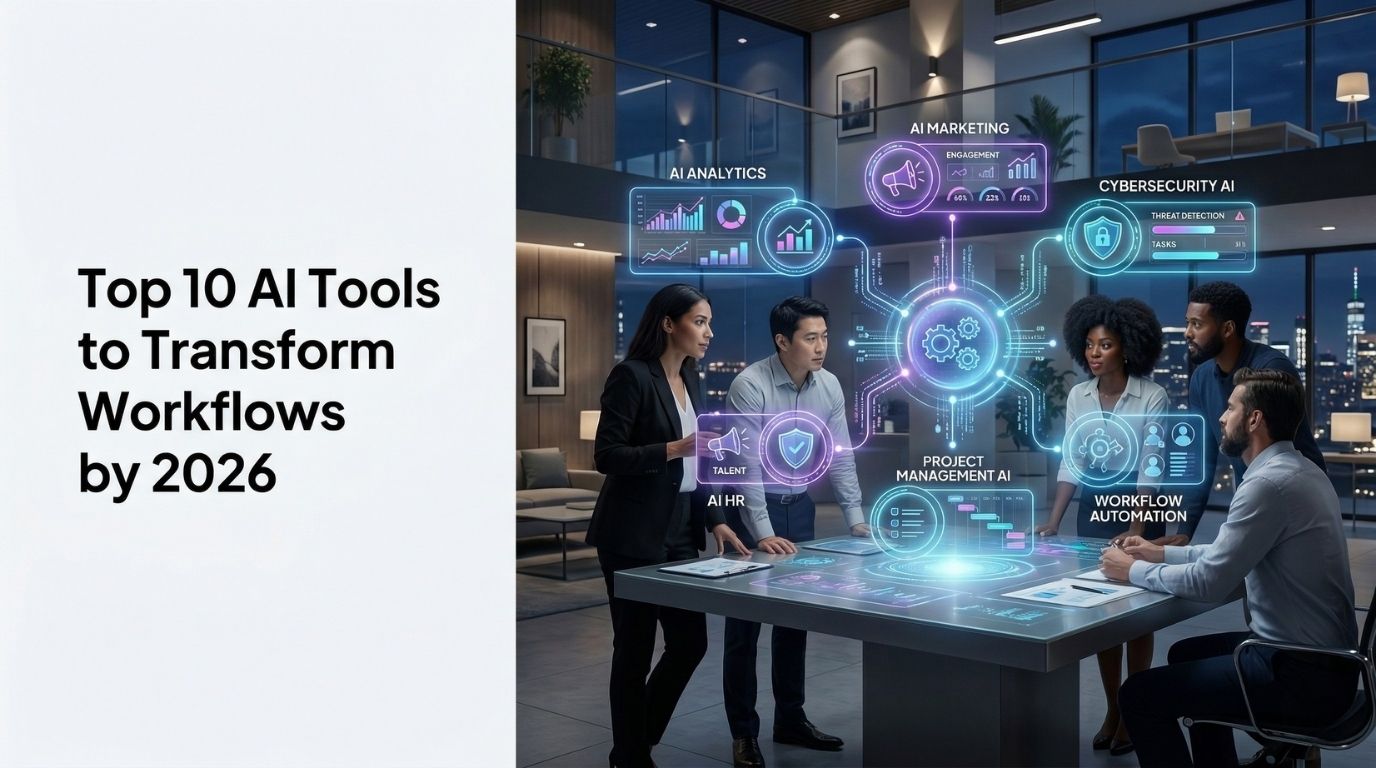
The pace of technological advancement, particularly in artificial intelligence, has never been more breathtaking. What was once the realm of science fiction is now becoming an integral part of daily business operations, fundamentally altering how organizations create value, interact with customers, and manage their internal processes. As we hurtle towards 2026, AI is poised to move beyond mere augmentation to become a truly transformative force, driving unprecedented levels of efficiency, innovation, and strategic advantage. Businesses that fail to recognize and adapt to this shift risk being left behind in an increasingly competitive landscape. This article delves into the top 10 AI tools projected to revolutionize workflows by 2026, offering a strategic roadmap for enterprises seeking to harness the full potential of this groundbreaking technology.
The AI Imperative: Why 2026 is a Game-Changer
The trajectory of artificial intelligence has been nothing short of exponential. From foundational machine learning algorithms to sophisticated neural networks capable of complex reasoning, AI has matured rapidly. By 2026, we anticipate a pivotal shift from experimental AI deployments to widespread, deeply integrated AI ecosystems within enterprises of all sizes. This evolution is driven by several factors: the increasing availability of vast datasets, significant advancements in processing power, and the development of more accessible and user-friendly AI platforms.
The imperative to adopt AI is no longer a matter of competitive advantage but one of survival and sustained growth. Organizations that proactively integrate AI into their core operations will unlock new levels of productivity, gain deeper insights from their data, and deliver hyper-personalized experiences to their customers. A report by PwC suggests that AI could contribute up to $15.7 trillion to the global economy by 2030, with much of that growth beginning to materialize in the mid-2020s. This isn't just about automating repetitive tasks; it's about empowering human capital with intelligent tools that augment decision-making, foster creativity, and enable strategic foresight. The year 2026 will mark a critical inflection point where AI transitions from a specialized tool to an indispensable component of every modern workflow.
"AI in 2026 will not just be about doing things faster; it will be about doing fundamentally new things, enabling business models and customer experiences previously unimaginable."
Criteria for Selection: Identifying Transformative AI
Identifying the "top" AI tools for 2026 requires a forward-looking perspective, considering not just their current capabilities but their anticipated evolution and impact. Our selection methodology is rooted in several key criteria designed to pinpoint tools with genuine transformative potential for business workflows.
Innovation and Future-Proofing
The selected tools must demonstrate significant innovation beyond incremental improvements to existing technologies. We prioritize solutions that are pushing the boundaries of what AI can achieve, whether through novel algorithms, unique application areas, or groundbreaking architectural designs. Furthermore, these tools must exhibit a degree of future-proofing, meaning they are designed to adapt and scale with evolving data landscapes and technological advancements. Their underlying frameworks should be robust enough to integrate new research findings and maintain relevance in a rapidly changing environment, ensuring long-term value for adopting organizations.
Integration Capabilities
In a complex enterprise environment, no tool operates in isolation. The ability of an AI solution to seamlessly integrate with existing software, databases, and operational systems is paramount. We look for tools that offer open APIs, robust SDKs, and compatibility with common enterprise platforms (e.g., ERP, CRM, cloud services). Easy integration minimizes implementation hurdles, reduces data silos, and ensures that AI insights can flow effortlessly across departments, maximizing their utility and preventing fragmented adoption. Tools that act as central intelligence layers, connecting disparate systems, are particularly valued.
User Experience and Accessibility
For AI to truly revolutionize workflows, it must be accessible and intuitive for a broad range of users, not just data scientists. Our criteria emphasize tools with well-designed user interfaces, clear reporting mechanisms, and low-code/no-code options where appropriate. A positive user experience encourages adoption, reduces training overheads, and empowers business users to leverage AI capabilities directly, fostering a culture of data-driven decision-making throughout the organization. Tools that offer clear explanations for their outputs (interpretability) also score highly, building trust and facilitating better understanding.
Impact on Productivity and ROI
Ultimately, the most transformative AI tools are those that deliver tangible business value. We assess tools based on their potential to significantly enhance productivity, streamline operations, reduce costs, drive revenue growth, or unlock new market opportunities. This includes quantifiable metrics such as time saved, error reduction, conversion rate improvements, or accelerated innovation cycles. A strong return on investment (ROI) is a critical indicator of a tool's effectiveness, signaling its capacity to not only optimize current processes but also create sustainable competitive advantages. Solutions that clearly articulate their value proposition and demonstrate measurable outcomes are prioritized.
Top 10 AI Tools for 2026: Revolutionizing Your Workflow
Based on our stringent criteria, the following AI tools are poised to redefine business workflows and operational paradigms by 2026, offering unprecedented opportunities for efficiency, innovation, and strategic growth.
1. Advanced Predictive Analytics Platforms
By 2026, predictive analytics platforms will move beyond simple forecasting to offer highly granular, real-time insights across every facet of a business. Leveraging sophisticated machine learning models, these tools will analyze vast streams of historical and real-time data from diverse sources – including IoT sensors, social media, transaction records, and external market indicators – to anticipate future trends with remarkable accuracy. They will predict customer churn before it happens, identify emerging market demands, forecast supply chain disruptions, and even pre-empt equipment failures. These platforms will feature intuitive dashboards, allowing business users to explore "what-if" scenarios and understand the drivers behind predictions. Their revolution lies in proactive decision-making; instead of reacting to events, businesses will be able to shape outcomes, optimizing resource allocation, inventory management, and marketing campaigns with unprecedented precision. For instance, a retail business could predict seasonal demand variations for specific product lines weeks in advance, optimizing stock levels and promotional strategies to maximize sales and minimize waste.
2. Hyper-Personalized Marketing & Sales Engines
The era of mass marketing is long past. By 2026, AI-powered marketing and sales engines will deliver hyper-personalized experiences at scale, dynamically tailoring every customer interaction. These tools will integrate data from CRM systems, browsing history, purchase patterns, social media engagement, and even biometric data (with consent) to create incredibly detailed customer profiles. They will then use generative AI to craft personalized ad copy, email content, product recommendations, and even conversational scripts for sales teams, all in real-time. The revolution here is the shift from segment-based personalization to true individualization, where every customer feels uniquely understood and valued. This leads to significantly higher conversion rates, increased customer loyalty, and optimized marketing spend. Imagine an AI sales assistant that not only identifies the perfect product for a prospect but also generates a personalized proposal document and suggests the optimal time for a follow-up call, all based on the prospect's real-time digital behavior.
3. Intelligent Automation & Robotic Process Automation (RPA) Suites
While RPA has been around for some time, by 2026, it will evolve into "Intelligent Automation" suites, combining traditional RPA with advanced AI capabilities like machine learning, natural language processing (NLP), and computer vision. These suites will not only automate repetitive, rule-based tasks but also handle unstructured data, interpret human language, and learn from exceptions. They will orchestrate complex end-to-end processes across multiple systems, making autonomous decisions and adapting to changing conditions. This revolutionizes back-office operations, customer service, and data entry, freeing human employees from tedious, high-volume tasks. For example, an intelligent automation suite could process incoming invoices, extract relevant data regardless of format, validate it against purchase orders, flag discrepancies for human review, and then initiate payment, all with minimal human intervention and continuous learning for improved accuracy.
4. Next-Gen Generative AI for Content Creation
Generative AI, exemplified by models like GPT-4 and its successors, will be indispensable for content creation by 2026. These tools will not merely assist but will autonomously generate high-quality text, images, videos, and even interactive experiences based on simple prompts or existing data. They will understand brand voice, target audience nuances, and SEO best practices, producing a vast array of content for marketing, technical documentation, internal communications, and creative industries. The revolution is in accelerating content production cycles from weeks to minutes, enabling businesses to maintain a constant, high-quality digital presence. While human oversight remains crucial for creativity and ethical considerations, these tools will empower content teams to focus on strategy and refinement rather than rote production. A marketing department could use generative AI to produce dozens of unique ad variations for A/B testing, localized content for different regions, and personalized email campaigns in a fraction of the time it currently takes.
5. AI-Powered Cybersecurity & Threat Intelligence
As cyber threats become more sophisticated, AI will be the frontline defense by 2026. AI-powered cybersecurity tools will move beyond signature-based detection to employ advanced machine learning and behavioral analytics, identifying anomalous patterns indicative of zero-day attacks, insider threats, and highly evasive malware in real-time. These systems will autonomously learn from network traffic, user behavior, and threat intelligence feeds to predict and neutralize threats before they can cause significant damage. They will also automate incident response, isolating affected systems and patching vulnerabilities. The revolution is in shifting from reactive security to proactive, intelligent defense, significantly reducing the window of vulnerability and the burden on human security analysts. For instance, an AI system could detect a subtle deviation in a user's login pattern or file access behavior, immediately flag it as suspicious, and temporarily lock the account, preventing a potential data breach.
6. Autonomous Project Management Assistants
Project management in 2026 will be significantly augmented by AI-driven assistants that go far beyond simple scheduling. These tools will analyze project data, team performance metrics, resource availability, and external factors to dynamically optimize project plans, identify potential bottlenecks, and predict completion dates with greater accuracy. They will intelligently reallocate tasks, suggest optimal resource utilization, and even communicate progress updates autonomously. The revolution lies in transforming project management from a reactive, manual process into a proactive, intelligent orchestration of tasks and resources, ensuring projects stay on track and within budget. These assistants will provide real-time risk assessments and suggest mitigation strategies, allowing human
7. AI-Driven Knowledge Management & Enterprise Search
By 2026, AI-powered knowledge management systems will act as a central intelligence layer for enterprises, turning scattered documents, wikis, emails, and chats into a searchable, living knowledge graph. Using semantic search and large language models, these tools will understand natural-language questions and return direct, context-aware answers rather than long lists of links. They will automatically classify content, detect duplicates, keep documentation fresh, and enforce granular permissions so that sensitive information is only visible to the right people.
The revolution here is the shift from “hunting for information” to “getting instant, trusted answers,” dramatically reducing time wasted searching across systems and asking colleagues for tribal knowledge. New employees will ramp up faster, support teams will resolve issues in minutes, and leaders will make decisions with a single source of truth instead of stale slides and siloed spreadsheets. Imagine an engineer asking, “What’s our latest refund policy for EU customers?” and receiving a precise, auto-summarized answer with links to the canonical documents in seconds—directly inside their chat or productivity tool.
8. AI-Powered HR, Talent, and Employee Experience Platforms
Human Resources will be transformed by AI platforms that manage the entire talent lifecycle—from hiring to development to retention—using continuous intelligence rather than occasional snapshots. These tools will screen resumes, optimize job descriptions, schedule interviews, and surface best-fit candidates based on skills, potential, and culture add, not just keyword matches. Once employees are onboarded, AI will personalize learning paths, coaching, and career recommendations based on performance data, role aspirations, and market skill trends.
AI-driven sentiment analysis will continuously monitor engagement signals across surveys, collaboration tools, and internal communications, flagging early signs of burnout or disengagement so HR can intervene proactively. Virtual HR assistants will answer routine questions 24/7—policies, leaves, benefits—freeing HR teams to focus on strategic initiatives. The revolution is a data-driven, always-on “people ops engine” that boosts retention, speeds hiring, and creates a more personalized, supportive employee experience at scale.
9. Autonomous Workflow Orchestration & AI Agents
Beyond individual tools, 2026 will see the rise of autonomous AI agents that orchestrate entire workflows across multiple systems without constant human prompting. These agents will interact with CRMs, project management platforms, communication tools, and data warehouses to execute multi-step processes: creating tasks, updating records, sending follow-ups, and escalating exceptions automatically. Instead of static if‑this‑then‑that rules, they will learn from historical data and user feedback to improve over time, much like a digital chief-of-staff coordinating behind the scenes.
The revolution is moving from “automated tasks” to “self-running business processes.” For example, when a major incident is detected in production, an AI agent could spin up a war-room channel, assemble the right experts, pull relevant dashboards, draft customer communication, and open follow-up tasks—before any manager even logs in. This level of orchestration compresses response times, reduces coordination overhead, and lets human teams focus on high-judgment decisions rather than status chasing.
10. Strategic AI Co-Pilots for Leadership and Decision-Making
By 2026, executives and managers will rely on strategic AI co-pilots that synthesize signals across finance, operations, customer feedback, and market data into clear, actionable insights. These assistants will generate scenario models, highlight emerging risks and opportunities, and propose data-backed recommendations—complete with projected impact and confidence intervals. Instead of spending hours assembling reports, leaders will ask questions in natural language (“How will a 5% price increase affect churn in EMEA?”) and receive concise analyses, visualizations, and suggested next steps.
The revolution is a step-change in strategic agility. Leadership teams will iterate on strategy weekly rather than quarterly, run rapid experiments, and course-correct based on live data rather than backward-looking metrics. Combined with the other tools on this list, AI co-pilots will ensure that decisions at every level—from frontline supervisors to the C‑suite—are informed, transparent, and aligned to real-time business realities.